PROFILE Projects experiences as senior consultant, Interim manager, project manager and project director in the Netherlands and International projects (North, Mid and South America, Dutch Antilles, Asia, Saudi Arabia, UK, Rusia, China). Conceptual approach with a focus on project results, business processes and a strong human resource approach. International oriented and experiences in multidisciplinary investment projects and Reliability & Maintenance such as APM & RM (Asset Performance Management & Risk Management) with life cycle investments.
Hands on and realistic in decision making
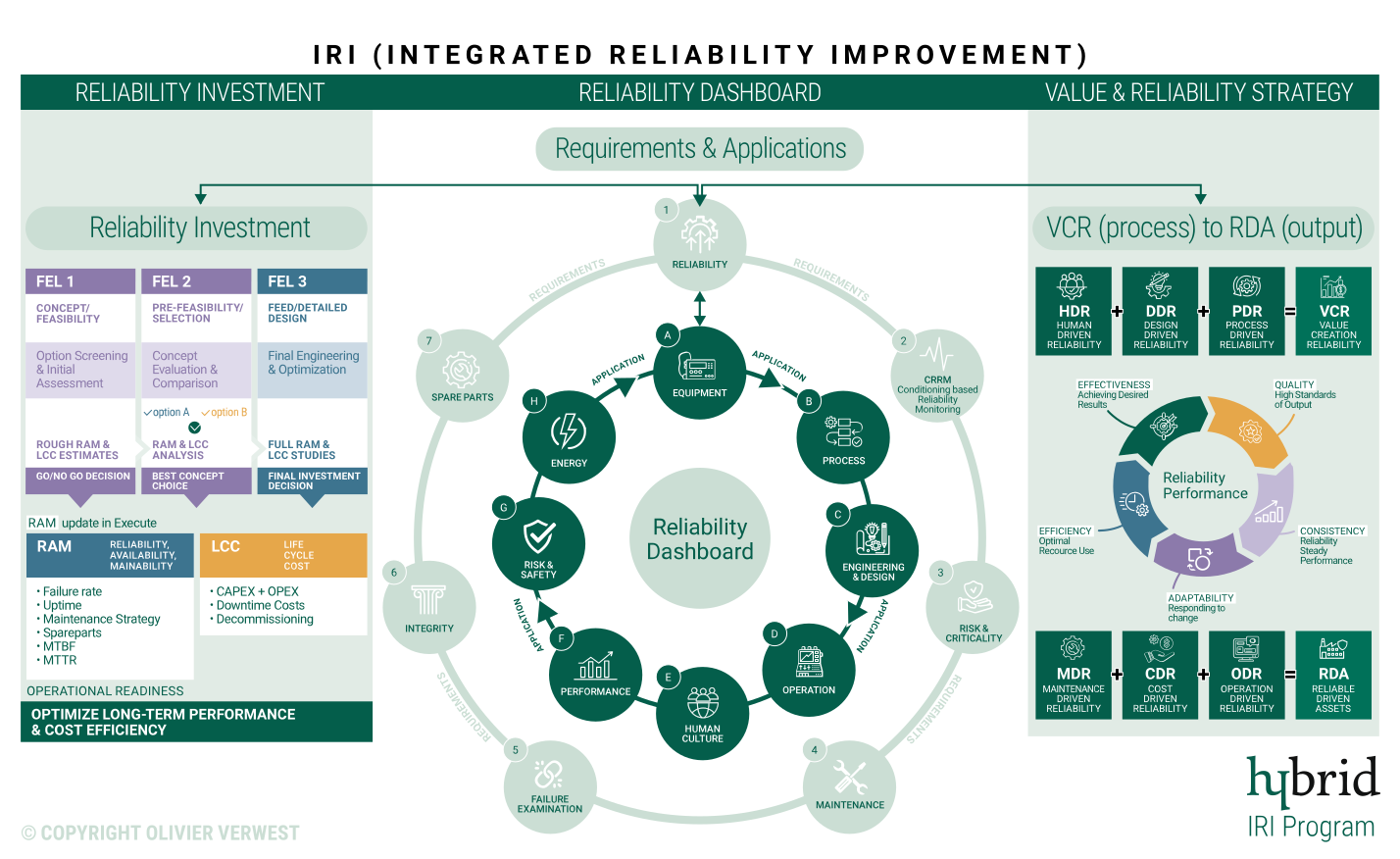
Integrated Reliability Improvement (IRI) is a holistic approach that systematically enhances the performance, safety, and cost-effectiveness of industrial systems by integrating multiple disciplines into a unified framework. Rather than treating reliability as a standalone engineering function, IRI connects engineering, maintenance, operations, risk management, and financial analysis to optimize the entire lifecycle of assets. This integrated perspective is particularly important in industries such as chemicals, where complex processes, continuous production, and high-risk environments demand consistent and reliable performance. At its core, IRI begins with a clear understanding of asset reliability requirements, which are defined based on production needs, safety constraints, and economic impact. This is followed by risk and criticality assessment, where assets are prioritized according to their potential consequences of failure. High-criticality assets, such as pumps, compressors, or reactors, receive focused attention because their failure can lead to significant production losses or safety incidents. A key element of IRI is the use of Reliability, Availability, and Maintainability (RAM) analysis, which quantitatively evaluates system performance in terms of uptime, failure behavior, and repair efficiency. RAM models help predict system availability, identify bottlenecks, and assess the impact of design or maintenance changes. This supports reliability investment decisions, such as adding redundancy or improving maintenance strategies, by demonstrating their effect on system performance and economic outcomes. Another essential component is Life Cycle Costing (LCC), which evaluates the total cost of an asset over its entire lifecycle, including CAPEX, OPEX, maintenance, and downtime costs. LCC ensures that decisions are not based solely on initial investment but on long-term value, enabling organizations to select solutions that minimize total cost of ownership while maintaining required reliability levels. IRI also incorporates condition-based monitoring (CBM) and data analytics. By continuously monitoring parameters such as vibration, temperature, and pressure, early signs of degradation can be detected. This enables predictive maintenance, reducing unplanned downtime and extending asset life. However, IRI goes beyond monitoring by incorporating failure elimination, which focuses on identifying and removing root causes of recurring failures through engineering improvements or design modifications. Maintenance within IRI is not generic but strategy-driven. Techniques such as Reliability-Centered Maintenance (RCM) are used to determine the most appropriate maintenance approach for each failure mode—whether preventive, predictive, or run-to-failure. This ensures that maintenance activities are both technically effective and economically justified. At the same time, integrity management ensures that equipment operates within safe limits, preventing catastrophic failures and ensuring compliance with regulatory requirements. Another critical component is spare parts management, which ensures that critical components are available when needed, minimizing repair times and reducing downtime. Efficient spare parts strategies are aligned with asset criticality and failure probability, avoiding both shortages and excessive inventory costs. IRI also emphasizes the importance of human factors and organizational culture. Reliable systems depend not only on technology but also on how people operate, maintain, and manage assets. Training, clear procedures, and a culture of ownership and continuous improvement are essential to sustain reliability gains. Importantly, IRI integrates financial considerations into technical decision-making. By quantifying the cost of unreliability—such as downtime, maintenance, and risk exposure—organizations can prioritize investments that deliver the highest return. Reliability investments are evaluated using RAM and LCC insights to ensure that improvements increase availability while reducing total lifecycle costs. In conclusion, IRI provides a comprehensive framework that aligns technical reliability with operational performance and financial outcomes. By integrating RAM analysis, LCC, and cost-driven decision-making, it enables organizations to achieve safer operations, higher availability, and optimized total cost of ownership.